
The technical champion trap
When your biggest advocate can't close the deal

From deep tech implementation to business development, from closing deals to analyzing why they close, from market positioning back to writing inference pipelines.
I've been cycling through these for years and still find something new in each loop.
I'm building in public now because we shipped something I've wanted years ago.
Narrio launched 8 months ago as a spinoff from Cube Digital.
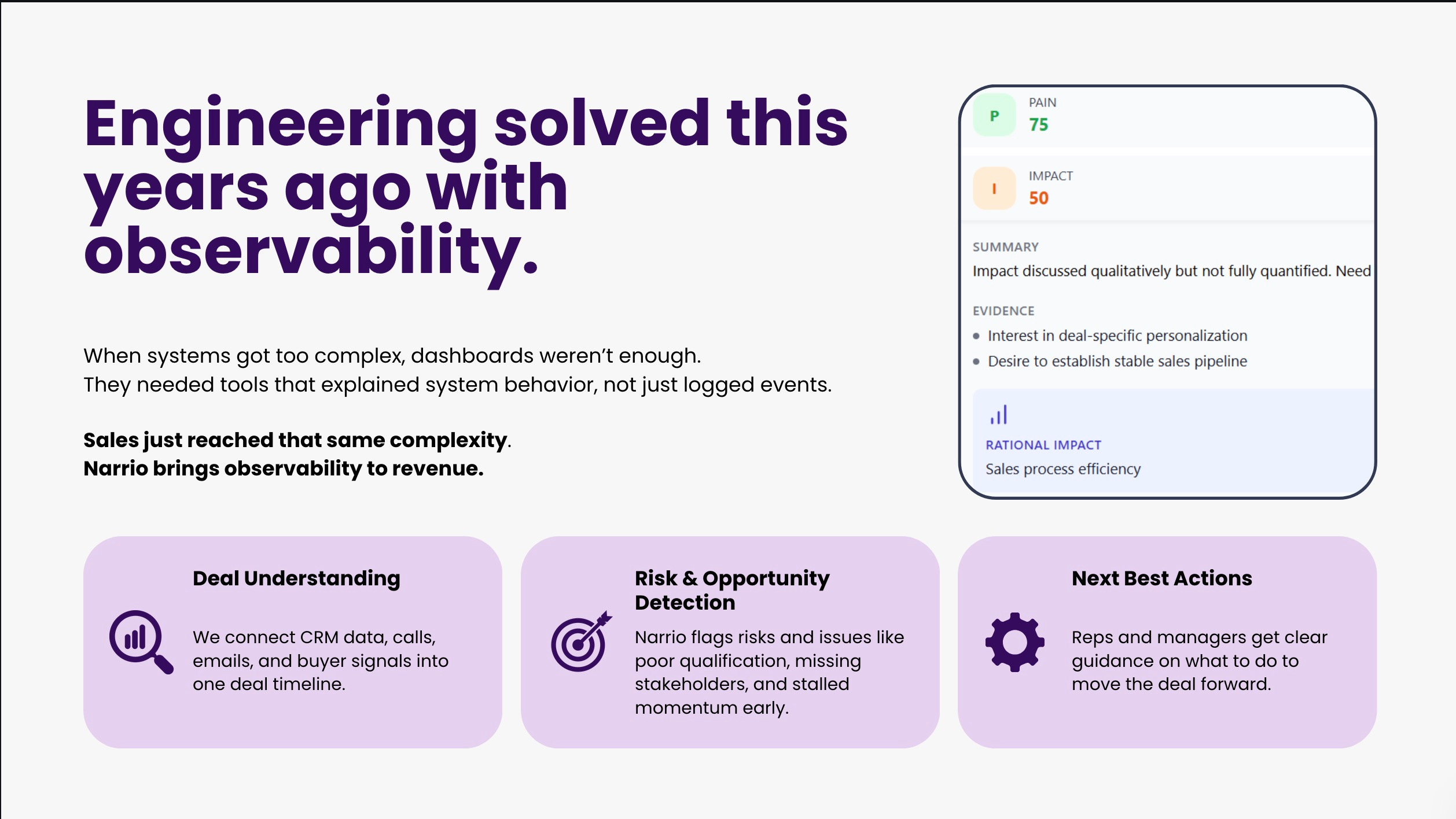
My co-founders and I spent those months building a sales observability layer that does what engineering observability did for complex systems: explains behavior, not just logs events.
The product runs on specialized small language models trained specifically for revenue signal detection.
This article series documents what we learned analyzing deal patterns across deep tech sales cycles. The data comes from real pipelines. The problems are the ones I've watched kill forecasts repeatedly. The solutions are what we built Narrio to address. If you're selling products with 4+ month cycles and 4+ stakeholders, you've seen these patterns. You probably didn't have the tooling to act on them early enough.
Want to see these patterns in your pipeline? We run 20-minute analysis sessions using your actual deal data.
Book here: https://2f308h.share-eu1.hsforms.com/25ML7CmLiRp2FS_aCnCEPbw
Is this article for you?
Maybe you’re an engineer who just wants to build cool inference pipelines and couldn’t care less about sales cycles.
Fair. But here’s the thing: when your company’s forecast misses by 40% two quarters in a row, your next sprint planning meeting includes the phrase “headcount freeze.”
The CEO starts asking why engineering keeps building features nobody’s buying. Your roadmap gets cut. Your architecture decisions get second-guessed. Suddenly that sales problem is your problem.
Maybe you’re in sales or RevOps and you clicked this because the title called you out. You’ve got a pipeline full of “engaged” prospects and a forecast that keeps degrading. Your VP asks what happened to that $500K deal that was “90% close” last month. You’re explaining for the third time why technical validation doesn’t mean budget approval. You’re tired. We get it.
Maybe you’re a founder or revenue leader watching your win rate drop while your team insists they’re “doing everything right.” More activities logged, more demos delivered, fewer deals closed. Something broke and nobody can tell you what because your CRM tracks events, not patterns.
Also, if you’re an engineer and you’re thinking “this could increase my salary if the company actually closes more deals,” you’re not wrong. Make the intro. Help your sales team. Get that raise.

For sure you were in the situation when your tech star champion scheduled another demo. A lot of engineer came from their team. You offered everything: API documentation, security certifications, integration guides, PoCs, etc. You responded to emails within hours for moths.
The deal closed-lost “suddenly” 11 months later. The budget has never materialized.
Forrester's 2024 research shows 86% of B2B purchases stall during the buying process.
The AE logs 40+ activities. Engineering signs off on the POC. The champion rates the product 9/10. Then radio silence for eight weeks until someone admits budget approval failed.
Want to see these patterns in your pipeline? We run 20-minute analysis sessions using your actual deal data.
Book here: https://2f308h.share-eu1.hsforms.com/25ML7CmLiRp2FS_aCnCEPbw
The Authority problem nobody tracks
Forrester’s 2024 State of Business Buying Report says the typical B2B purchase now ropes in 13 different people. Almost 90% of the time, these decisions bounce across several departments. Gartner’s numbers are a bit lower, around 6 to 10 people for more complicated B2B solutions.
When we dug into 180 enterprise deals, we saw technical champions jump in early, usually as the first or second player. They run proofs of concept, join integration calls, tackle architecture reviews. They’re the ones checking if the tech actually holds up. But here’s the thing, they can’t just pull $500K out of next year’s budget.
We tracked who actually holds the purse strings in those same 180 deals. On average, technical champions could directly spend about $18K. Some had no spending authority at all. They shape the evaluation, sure, but when it comes to signing contracts, they’re not the ones with the final say. In deals that closed, people with procurement authority usually showed up within the first 60 days. But in deals that dragged out after technical validation, the first real budget decision-maker didn’t show up until after day 180.or sometimes, not at all.
That’s the difference between a six-month proof of concept turning into a win, or quietly fading away eleven months later.
What POC completion actually proves
Gartner thinks that by the end of 2025, about 30% of Generative AI projects will get dropped after the proof-of-concept stage.
Not because the tech doesn’t work, but because of
messy data
weak risk controls
runaway costs
fuzzy sense of whether the project matters to the business.
The real issue isn’t always about technology falling short. A PoC just proves the tech can work, not whether it actually deserves time, money and people.
Most big companies, around 78%, according to Gartner, run some sort of POC or pilot before they buy software.
But here’s the twist: SaaS pilots turn into real deals anywhere from 60% to over 90% of the time, and speed matters. The faster a solution moves into production, the better the odds. Usually, there’s a technical champion pushing things forward. They gather evidence, write up a business case, set up meetings with higher-ups, and show off results. But as soon as leadership starts grilling them about ROI, rollout timelines, business impact, or what competitors offer, things get shaky. The champion is ready to talk about how the tech works, but not about how it moves the needle for the business.
We’ve seen the pattern over and over: the technical part wraps up by month four. Then, between months five and seven, the champion tries to get internal buy-in. Leadership demands the numbers. By month eight, the deal’s stuck. By month eleven, it’s dead, usually with vague reasons like “bad timing” or “budget issues.”
Here’s what our data says: if a deal hasn’t shown real business value by day 23, it stalls out 90% of the time. Not technical value,business value. The technical folks want to prove the system works, but the people with the checkbook want to see it solve a problem that justifies the spend.
Dentsu’s research in 2024 found it now takes, on average, 379 days to go from first spotting a problem to actually signing the deal. That’s up 16% since 2021. The process isn’t just getting slower. It’s getting more complicated and scattered.
The Stakeholder composition signal
You can spot early budget authority engagement just by looking at who shows up to meetings. Deals that actually close tend to pull in bigger stakeholders over time. First week, you’ll see an engineer. By week three, an engineering manager. Week six, a director steps in. By week eight, a VP joins, often with someone from finance or ops. If you’re three months in and still meeting only with individual contributors or a lone technical manager, that’s a sign, the economic buyer’s missing.
Younger decision-makers, especially those under 40, pull almost twice as many people into the process, on average, 6.8 stakeholders versus 3.5 for older execs. Sopro’s 2024 research calls this out, and, honestly, it just makes everything more complicated.
The way people talk changes once the budget authority gets involved. We dug into 4,200 sales emails from 180 different deals to see how. When the conversation’s still technical, emails have about 3.2 questions per message, mostly about features and how things fit together.
Once budget talk starts, that drops to 1.8 questions per email, now focused on pricing and procurement. If a deal stays stuck in technical talk past 120 days, close rates tank, from 45% down to just 18%.
How fast people respond tells its own story. If you get same-day replies for three months, then suddenly it stretches to three or four days, that usually means something’s jammed up inside. If folks start rescheduling meetings. going from none to two a month. priorities are clashing or you’ve lost your path to the decision-makers.
When questions shift from “how does this work” to “who needs to review this,” your champion’s probably hit a wall they can’t get through on their own.
A pattern from real pipeline data
An AI infrastructure company spent six months running a proof of concept with a big-name Fortune 500 prospect. Their main contact? A senior ML engineer who handled integration, shared results with his team, and kept the feedback coming, week after week. For the first four months, things looked great. The emails flew back and forth, multiple times a week, always detailed, always quick. Every message dug into technical details.
But things shifted in month five. Suddenly, replies took three or four days instead of a few hours. The questions changed, too. no more talk about model versioning or architecture. Now it was “Who handles the contract?” Meetings slipped, got bumped twice before finally happening. Still, the account exec kept the deal marked at 80% confidence. In the CRM, activity looked solid.
By month six, the champion finally let something slip: he’d spent two months just trying to get his VP’s attention for budget sign-off. Turns out, the company had quietly put a freeze on spending, and nobody outside knew.
Thirty-eight days later, the deal died.
Here’s the real problem: the gap with the economic buyer was there from the start. The technical team loved the solution, but that masked the fact that procurement wasn’t really moving. By the time anyone tried to get approval, it was too late, the window had slammed shut.
What teams actually need to track
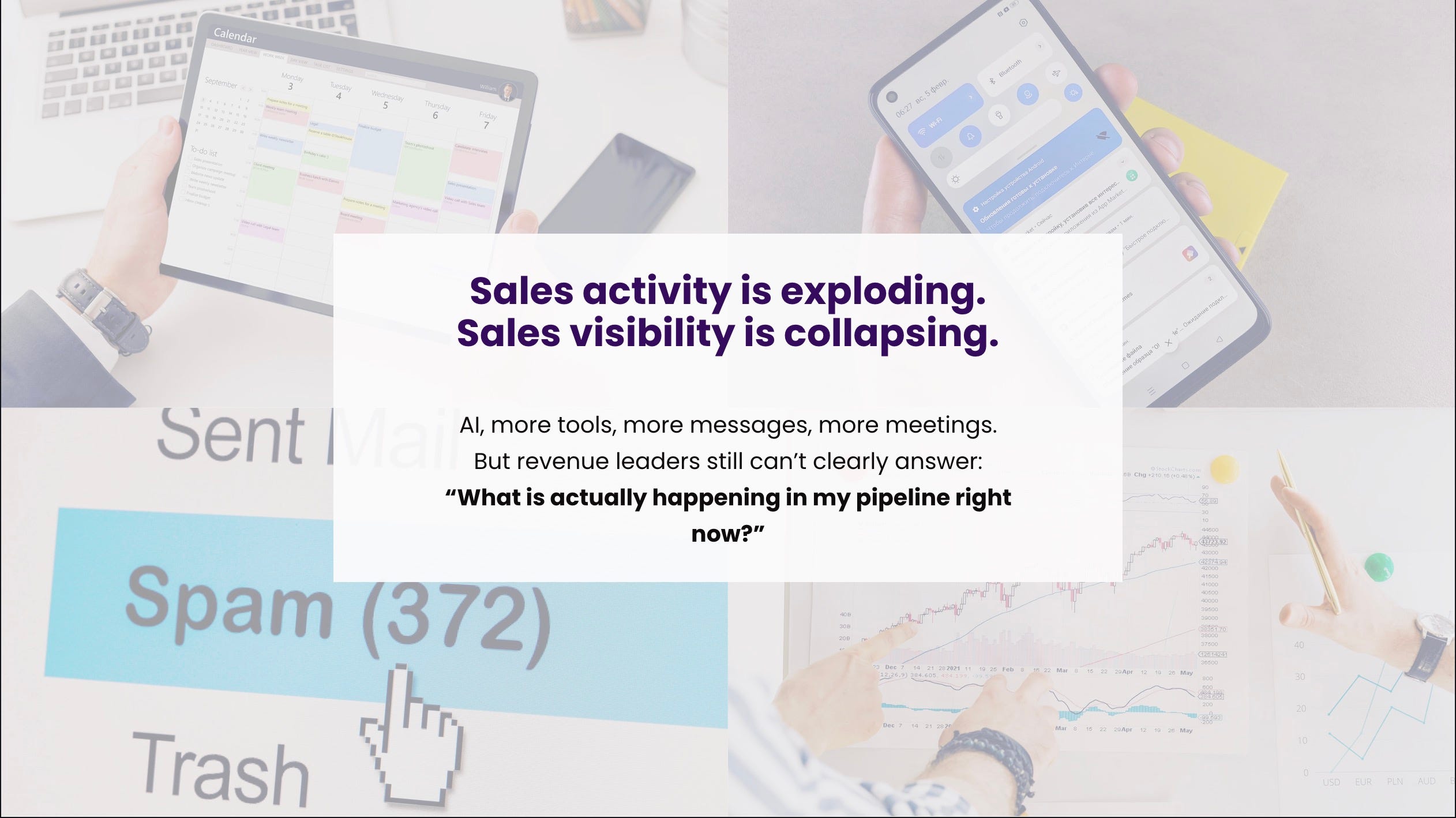
An AE managing six concurrent deals processes 200+ conversations monthly. Before each of those 20 weekly meetings, reps spend 27 minutes reconstructing context from CRM notes, email threads, call transcripts, and Slack messages. That’s 9 hours per week playing detective before executing any sales action.
Manual tracking of meeting composition, language evolution, response time degradation, and stakeholder expansion patterns fails at this volume. The patterns exist in the data. Most teams lack systems to surface them before deals stall.
How Narrio detects these patterns
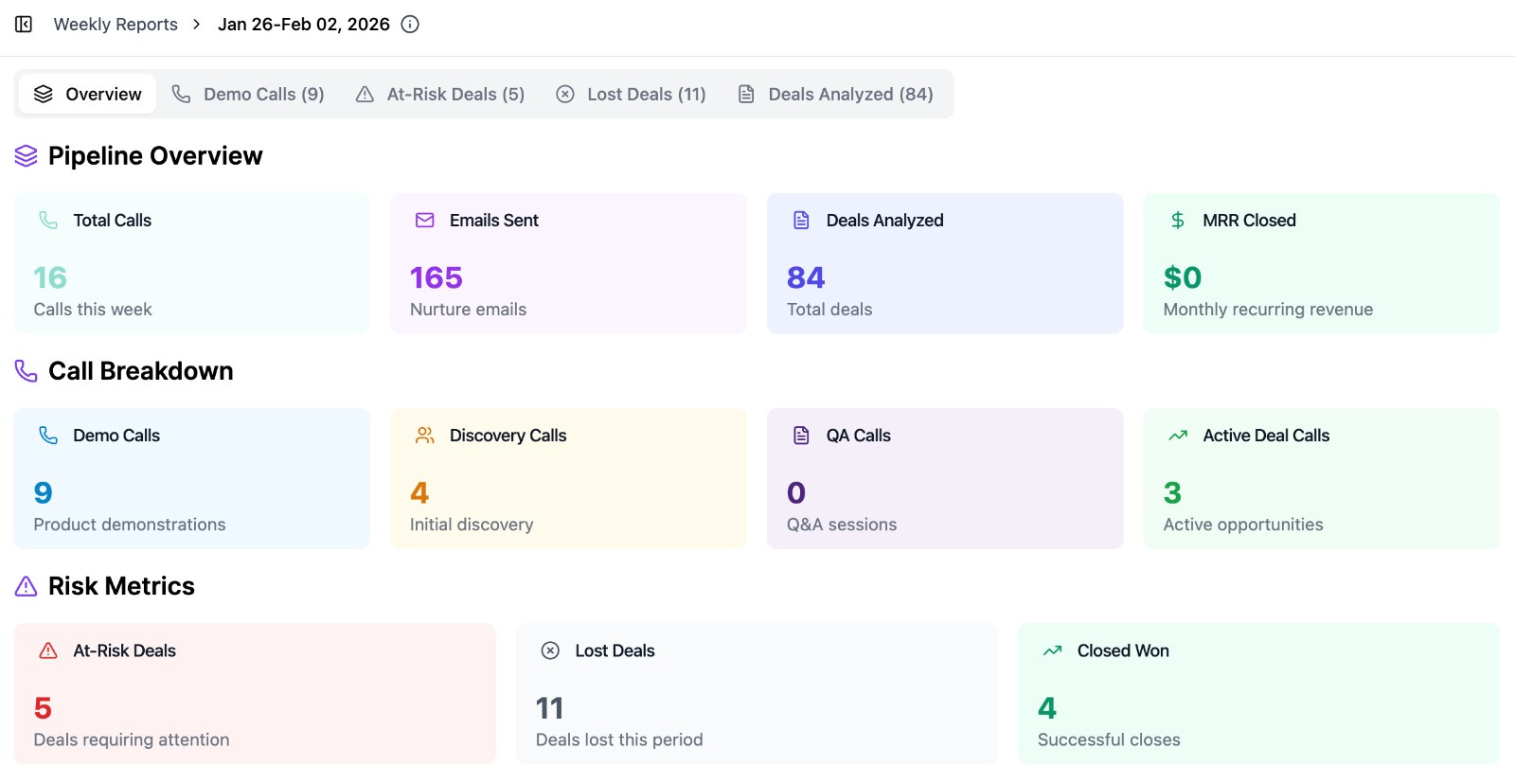
We built Narrio because revenue teams can’t see deal risk until it kills the forecast. The system connects CRM data, call transcripts, email threads, and buyer signals into a unified deal timeline. Specialized small language models trained on revenue signal detection analyze conversation patterns across all channels.
The system flags three risk categories:
Poor qualification – Business value discussion absent by day 23 triggers an alert. The system detects when conversations stay in technical validation mode past the point where successful deals shift to business impact discussions.
Missing stakeholders – Deal stakeholder composition flat for 45+ days despite consistent activity. Technical validation completing without economic buyer involvement. The system calculates time to likely stall based on historical patterns in similar deals.
Stalled momentum – Response time shifts from same-day to 3-4 days. Meeting reschedule frequency increases. Question types evolve from technical to procedural. Engagement patterns change. All factor into the momentum score.
The system operates at three levels:
Daily deal execution – Reps get meeting prep context, risk signals, clear next steps, email follow-up guidance. Every deal has direction instead of guesswork.
Weekly pipeline reviews – Managers see what actually moved, what’s stuck, which deals show early risk. Focus shifts to real issues instead of status updates.
Monthly/quarterly pipeline audits – Leadership sees where deals stalled, where risk builds, patterns across the pipeline. Decisions based on pipeline quality, not just volume.
Results across roles:
Revenue leaders – Pipeline risk visibility before it hits forecast. Fewer surprise misses. Forecast conversations based on signals instead of stories.
Sales managers – Deal health view before pipeline reviews. Early risk detection. Coaching focused where it matters.
Account executives – Complete deal timeline with full context. Clear next actions. Better prep for every meeting.
Measured outcomes:
Follow-up prep: 2 hours → 10 minutes
Content relevancy: +40%
Deals closed per rep: +20%
Spotting things early gives you a real chance to step in and make a difference. Teams start reaching out, trying to connect with the people who actually control the budget.
The talk moves away from just showing off features and gets into the real numbers, what impact will this actually have on the business?
You build the financial argument together, so the champion isn’t left pitching it solo. Wait too long, though, and you end up just watching deals slowly fall apart through three rounds of forecast updates, even as all the usual activity metrics say everything’s fine.
20-Minute pipeline analysis session
We run these pattern detection sessions using actual pipeline data. The process takes 20 minutes.
You bring 3-5 active deals from your CRM. We show you which economic buyer gaps exist, where momentum shifted, what the language patterns reveal about deal health.
The session covers stakeholder composition analysis across your deals, response time degradation patterns, and the specific day each deal shifted from technical to procurement language or failed to make that shift.
Book here: https://2f308h.share-eu1.hsforms.com/25ML7CmLiRp2FS_aCnCEPbw
Questions:
https://www.linkedin.com/in/mirceaserediuc/
https://www.linkedin.com/in/alexandra-botezatu/

Next in this series: Why your forecast in deep tech is fiction, and what to track instead.
Excellent breakdown! The day 23 business value threshold is surprisingly precise and alings with my experience in enteprise sales. I've watched too many POCs drag past 120 days because we celebrated technical buy-in without mapping budget authority. The response time degradation pattern is spot on, that 3-4 day shift from same-day replies almost always means internal friction nobody wants to mention.